| Trial Design Summary | |
| Key study parameters | |
| Study Parameter | Description |
|---|---|
| Study Type | Randomized controlled trial, noninferiority design |
| Primary Endpoint | Overall survival (OS) |
| Sample Size | 1,132 patients (per-protocol population) |
| Age Range | 18-60 years |
| IDAC Dose | 1,500 mg/m² every 12 hours |
| HDAC Dose | 3,000 mg/m² every 12 hours |
| Treatment Schedule | Days 1, 3, and 5 for up to 3 cycles |
7 Consolidation Therapy in AML
7.1 IDAC vs HiDAC for consolidation Therapy
7.1.1 Study Overview
This document summarizes the key findings from the randomized controlled trial by (Hunault et al. 2025) comparing intermediate-dose cytarabine (IDAC) with high-dose cytarabine (HDAC) as postinduction therapy in acute myeloid leukemia (AML) patients.
7.1.2 Trial Design
7.1.3 Patient Characteristics
7.1.3.1 Baseline Demographics
| Baseline Patient Characteristics | ||
| Per-protocol population | ||
| Characteristic | HDAC Group | IDAC Group |
|---|---|---|
| Number of patients | 572 | 560 |
| Median age (IQR) | 50 (40-56) | 50 (42-55) |
| Male sex (%) | 51.4% | 51.1% |
| De novo AML (%) | 94.4% | 93.4% |
| CR/CRi at randomization (%) | 78.7% | 79.1% |
7.1.3.2 Risk Classification
| ELN 2022 Risk Classification | ||
| Distribution by treatment group | ||
| Risk Group1 | HDAC n (%) | IDAC n (%) |
|---|---|---|
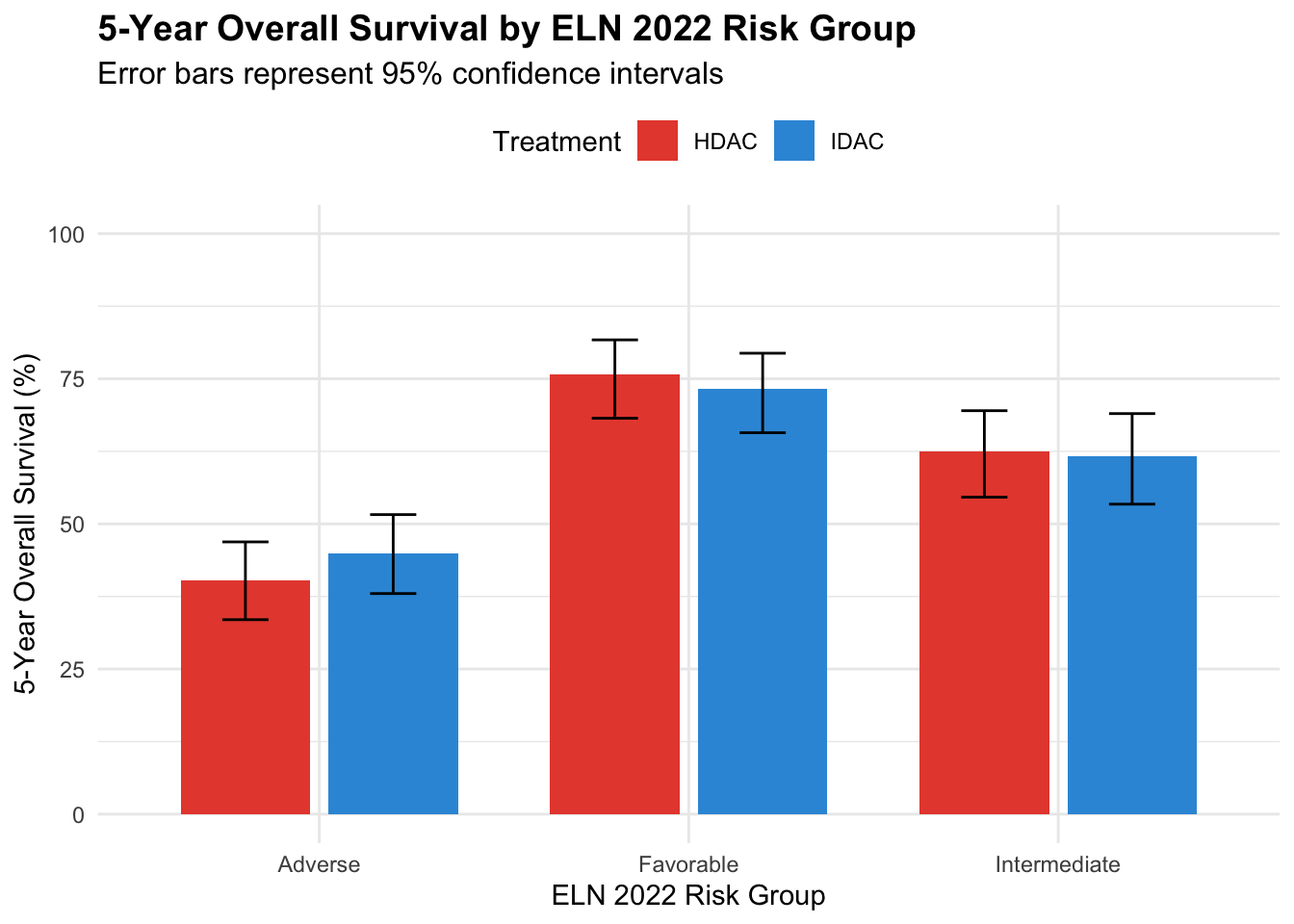
| Favorable | 158 (27.6%) | 169 (30.2%) |
| Intermediate | 166 (29.0%) | 159 (28.4%) |
| Adverse | 221 (38.7%) | 207 (40.0%) |
| 1 27 patients in HDAC and 25 in IDAC were not classified | ||
7.1.4 Primary and Secondary Outcomes
7.1.4.1 Overall Survival Results
| Primary and Secondary Efficacy Outcomes | ||||
| 5-year estimates with 95% confidence intervals | ||||
| Endpoint | HDAC % (95% CI) | IDAC % (95% CI) | Adjusted HR | P-value1 |
|---|---|---|---|---|
| 5-year Overall Survival | 57.5 (53.3-61.5) | 59.3 (55.0-63.3) | 0.96 (0.80-1.15) | 0.0042*2 |
| 5-year Event-Free Survival | 41.0 (36.9-45.0) | 41.4 (37.2-45.5) | 1.09 (0.94-1.27) | NS |
| 5-year Relapse-Free Survival | 45.7 (41.2-50.0) | 47.5 (42.9-51.9) | 0.98 (0.82-1.16) | NS |
| Cumulative Incidence of Relapse | 42.7 (38.5-47.1) | 42.8 (38.5-47.3) | 1.02 (0.84-1.23) | NS |
| Cumulative Incidence of Death in CR/CRi | 11.4 (9.0-14.5) | 9.5 (7.2-12.5) | 0.84 (0.57-1.23) | NS |
| 1 NS = Not significant; HR = Hazard Ratio | ||||
| 2 *Noninferiority test p-value | ||||
7.1.4.2 Response Rates
| Response to First HDAC/IDAC Cycle | |||
| By baseline remission status | |||
| Patient Category | HDAC Group | IDAC Group | Difference |
|---|---|---|---|
| Patients in CR/CRi after induction | 438/450 (97.3%) | 432/443 (97.5%) | 0.2% |
| Patients with induction failure | 63/122 (51.6%) | 45/117 (38.5%) | -13.1% |
7.1.4.3 Safety Analysis
Toxicity Comparison
| Safety Profile Comparison | |||
| Key toxicities during Cycle 1 | |||
| Toxicity Parameter | HDAC1 | IDAC1 | P-value |
|---|---|---|---|
| Mean days with fever ≥38.5°C | 3.0 ± 4.6 | 2.2 ± 3.1 | <0.001 |
| Mean days with platelets <20 G/l | 11.2 ± 10.5 | 9.8 ± 10.9 | 0.032 |
| Mean RBC transfusions (units) | 6.7 ± 6.0 | 5.8 ± 4.2 | 0.002 |
| Mean platelet transfusions (episodes) | 7.1 ± 6.6 | 6.3 ± 5.7 | 0.034 |
| Grade 3-4 hemorrhage (%) | 8.3% | 5.3% | 0.040 |
| Grade 3-4 vomiting (%) | 11.3% | 7.0% | 0.009 |
| 1 Values are mean ± SD or percentage | |||
7.1.4.4 Transplant Outcomes
| Transplantation Outcomes | ||
| HSCT rates and related mortality | ||
| Outcome Measure | HDAC Group | IDAC Group |
|---|---|---|
| Allogeneic HSCT in first CR/CRi | 260/572 (45.5%) | 240/560 (42.9%) |
| Median time to HSCT (days) | 99 (81-124) | 98 (80-119) |
| Total allogeneic HSCT | 412/572 (72.0%) | 401/560 (71.6%) |
| 3-year transplant-related mortality | 17.3% (13.2-22.5) | 16.3% (12.1-22.6) |
7.1.4.5 Subgroup Analysis
Overall Survival by ELN Risk Groups
7.1.5 Key Findings Summary
| Key Trial Findings | |
| Summary of main results | |
| Category | Key Result |
|---|---|
| Primary Outcome | IDAC showed noninferior OS compared to HDAC (59.3% vs 57.5% at 5 years) |
| Noninferiority | Noninferiority criterion met (p = 0.0042) |
| Safety Profile | IDAC associated with significantly less toxicity |
| Salvage Efficacy | HDAC showed higher salvage rate in refractory patients (51.6% vs 38.5%) |
| Transplant Rates | Similar transplant rates between groups (~72%) |
| Age Effect | Greater toxicity difference in patients ≥50 years old |
7.1.6 Conclusions & Clinical Implications
This trial demonstrates that intermediate-dose cytarabine (IDAC) is noninferior to high-dose cytarabine (HDAC) for postinduction therapy in AML patients aged 18-60 years, with the added benefit of reduced toxicity. These findings support the use of IDAC as a standard approach in this setting, particularly for patients at higher risk of treatment-related complications.
- IDAC can be used instead of HDAC without compromising efficacy
- Reduced toxicity with IDAC may allow for better tolerability and potential combination therapies
- Particularly beneficial for patients ≥50 years old
- Further research needed for patients >60 years old and alternative induction regimens